

How to Store Forklift Batteries Safely

A forklift left idle with the wrong battery storage conditions can become an expensive recovery job when demand returns. Knowing how to store forklift batteries correctly protects battery life, reduces safety risk and helps ensure equipment is ready when your warehouse, factory or site needs it.
The right approach depends on battery chemistry, how long the forklift will be out of service and the conditions at your premises. Lead-acid traction batteries and lithium-ion batteries have different storage needs, but both need a clean, dry, controlled area and a clear inspection routine.
Start with the battery type and storage period
Before taking a forklift out of operation, identify whether it uses a conventional flooded lead-acid battery, a sealed maintenance-free battery or a lithium-ion battery. Check the battery maker's instructions and the forklift manual, especially where the machine will be unused for more than a few weeks.
For short periods, a fully serviced battery can normally remain installed in the forklift, provided the key is removed, the machine is parked safely and no electrical accessories are left drawing power. Longer storage requires more planning. A neglected battery can self-discharge, sulphate internally or suffer damage from excessive heat, cold or moisture.
Lead-acid batteries need particular attention because they discharge gradually even when disconnected. Lithium-ion batteries usually have a lower self-discharge rate, but they must not be stored fully depleted or exposed to unsuitable temperatures. A battery management system may also continue to use a small amount of energy while the battery is idle.
How to store forklift batteries in the right environment
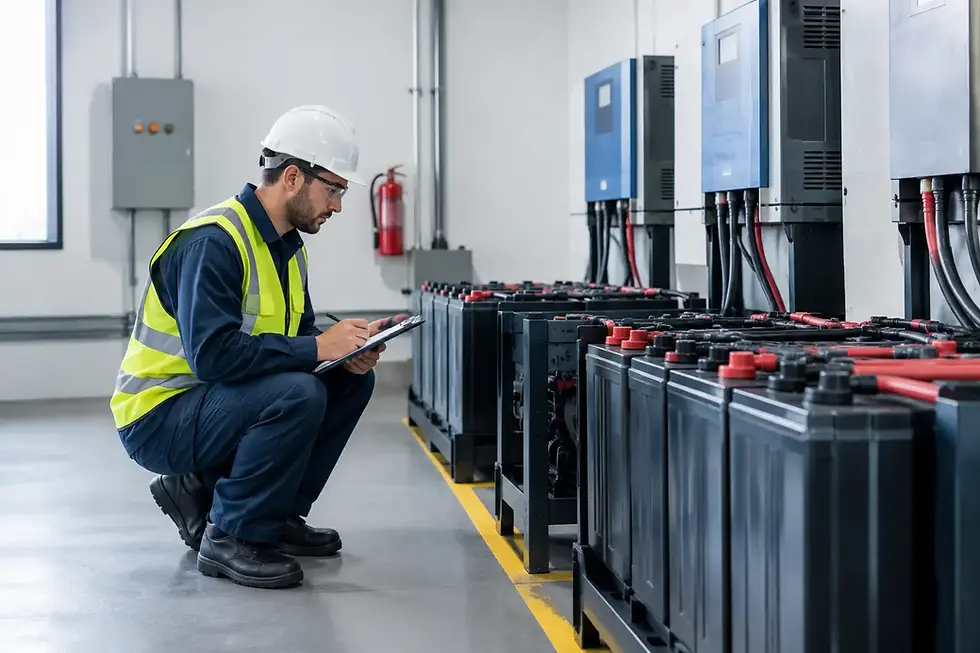
Choose a designated battery storage or charging area rather than an unused corner of the warehouse. The location should be dry, well ventilated, protected from direct sunlight and away from heat sources, sparks, welding work and combustible materials.
Keep batteries on a level, stable surface. Do not place them directly where standing water, wash-down spray or chemical contamination may reach the casing or terminals. If batteries are removed from forklifts, use suitable stands, pallets or battery trays designed to carry their weight. Forklift batteries are extremely heavy, and an unstable battery can cause serious injury or damage.
Temperature control matters. High temperatures speed up battery ageing and water loss in flooded lead-acid cells. Very low temperatures reduce available capacity and may create freezing risk in a discharged lead-acid battery. Lithium-ion batteries also require a temperature range specified by the manufacturer. A shaded, enclosed and ventilated battery area is generally more reliable than open outdoor storage in Malaysia's heat and humidity.
Keep adequate clearance around stored batteries so technicians can inspect them safely. The area should have clear warning signage, suitable fire controls, spill containment where lead-acid batteries are handled, and access restricted to trained personnel.
Prepare a lead-acid battery before storage
A lead-acid forklift battery should be clean, correctly charged and inspected before storage. Do not put away a battery that is already flat, hot, leaking or heavily corroded. Storage will not correct these problems. It usually makes them worse.
Begin by completing a proper charge cycle using the correct charger. Allow the battery to cool before inspection. Check the casing for cracks, swelling or signs of electrolyte leakage, then inspect cables, connectors and terminal covers for heat damage or corrosion.
For flooded batteries, check electrolyte levels only after charging and cooling, following the battery manufacturer's procedure. Use demineralised water where required. Overfilling is as problematic as underfilling because electrolyte can overflow during the next charge cycle and cause corrosion around the battery compartment.
Clean external surfaces with an approved battery cleaning method. Remove corrosion from terminals carefully and make sure cable connections are secure. Never use metal tools in a way that could bridge terminals and create a short circuit.
Once prepared, disconnect the battery from the forklift if the manufacturer or your maintenance procedure calls for it. Protect exposed connectors with their proper covers. Do not leave plugs on the floor where they can collect moisture, dirt or be damaged by passing equipment.
Store lithium-ion forklift batteries with manufacturer controls
Lithium-ion forklift batteries should be handled according to the battery and forklift manufacturer's storage guidance. Unlike lead-acid units, they do not require electrolyte checks or equalisation charging. However, they have their own risks and should not be treated as maintenance-free simply because they are sealed.
Store the battery at the recommended state of charge, which is commonly a partial charge rather than completely full or empty. The correct range varies by battery system, so the battery management system display and manufacturer guidance should take priority over a general rule.
Inspect the housing, high-voltage connectors, charging port and any warning indicators before storage. If the battery has been dropped, struck, overheated, exposed to water or shows a fault code, isolate it and arrange assessment by a competent battery technician. Do not attempt to open, repair or modify a lithium-ion battery pack onsite unless properly authorised and equipped to do so.
Lithium-ion batteries should never be stored beside flammable stock, waste materials or in an area exposed to extreme heat. A dedicated, monitored location gives site teams more control and makes abnormal conditions easier to identify early.
Maintain the battery while the forklift is idle
Storage is not a one-time task. Create a simple inspection schedule based on the expected idle period. For a forklift parked for several months, monthly checks are sensible. Record the inspection date, charge status, visible condition and any action taken.
For lead-acid batteries, measure and record voltage or state of charge in line with the battery supplier's recommendations. Recharge before the battery falls to a damaging level. Leaving a lead-acid battery partially discharged for extended periods encourages sulphation, reducing capacity and shortening service life. Depending on the charger and battery type, a periodic maintenance or refresh charge may be needed.
For lithium-ion units, check the state of charge and any battery management system alerts. Do not repeatedly top up a battery without reason if the manufacturer advises a storage charge range. The objective is stable, controlled storage, not constant charging.
During each inspection, look for leaking electrolyte, corrosion, loose cables, damaged insulation, unusual odours, swelling, overheating or signs of pest damage. Any of these conditions should take the battery out of normal service until it has been assessed.
Avoid common storage mistakes
The most costly mistake is parking a forklift with a discharged battery and assuming it will start again after a long shutdown. This often leads to reduced runtime, charging faults and an avoidable battery replacement.
Another common issue is using the battery room as general storage. Cardboard, timber, chemical containers and unused parts should not be piled around batteries or chargers. Keep the area tidy and make sure ventilation is not blocked.
Avoid charging damaged batteries, mixing chargers between incompatible battery types, or placing a battery on charge immediately after heavy use while it is still hot. Charging equipment must match the voltage, capacity and chemistry of the battery. A charger that is unsuitable or poorly maintained can cause undercharging, overcharging and premature battery failure.
Do not ignore the forklift itself. If the battery stays installed, check that the machine is parked on level ground with the forks lowered, parking brake applied and power isolated according to site procedure. Prevent unauthorised use while the equipment is out of service.
Bring stored batteries back into service carefully
When operations resume, inspect the battery before reconnecting it. Check its charge condition, casing, terminals, leads and connector. For lead-acid batteries, verify electrolyte level and charge the battery fully before returning the forklift to demanding work. For lithium-ion batteries, confirm that the battery management system shows no faults and that the battery is within its approved operating temperature range.
Run a short functional check on the forklift after installation. Watch for poor lifting performance, rapid discharge, connector heating or warning lights. These signs may point to battery deterioration, a charger issue or a fault in the forklift's electrical system.
Where a battery has been stored for a long period or has an uncertain history, professional testing is often the most cost-effective decision. A capacity test and inspection can identify whether the battery is fit for continued service before it causes disruption during a busy shift.
Good battery storage is part of uptime planning, not a housekeeping detail. A clean storage area, the correct charge routine and regular inspections give your team a better chance of putting every forklift back to work without an unexpected battery-related delay.


Comments