

How to Evaluate Used Forklifts Before You Buy

A used forklift that looks clean on the sales floor can still become a costly source of downtime once it starts working full shifts. The real question is not simply how to evaluate used forklifts by appearance. It is whether the machine can safely handle your loads, fit your site, and remain supportable when parts or repairs are needed.
For warehouses, factories and construction operations, a lower purchase price only delivers value when the forklift is reliable enough to keep materials moving. A structured inspection helps procurement teams avoid buying someone else’s maintenance problem.
Start with your operating requirement
Evaluate the forklift against the job it will perform, not against the advertised specification alone. Confirm the required lifting capacity, lift height, mast type, aisle width, tyre surface and expected daily operating hours. A 2.5-tonne forklift may be suitable on paper, but its actual rated capacity can reduce significantly when a longer attachment, high lift height or a different load centre is involved.
Check the data plate on the machine. It should show the model, serial number, rated capacity, load centre, mast configuration and any approved attachments. The information must match the forklift being inspected. If the plate is missing, damaged or inconsistent with the seller’s description, treat that as a serious concern. A replacement plate is not a casual paperwork matter - it must accurately reflect the machine’s tested configuration.
Also consider the environment. Pneumatic tyres may suit uneven outdoor yards, while cushion tyres are generally better for smooth warehouse floors. Electric forklifts are often preferred indoors because of emissions and noise, but battery condition becomes a major part of the purchase decision. Diesel and LPG units may offer longer continuous operation, although ventilation, fuel arrangements and local site requirements need to be considered.
Check the frame, mast and forks carefully
Begin with a visual inspection before starting the engine or connecting the battery. Look for cracks, heavy corrosion, fresh paint covering repairs, bent panels and evidence of impact around the counterweight, overhead guard and chassis. Cosmetic wear is normal. Structural repairs require closer scrutiny, particularly where welding appears around load-bearing areas.
The mast deserves particular attention because it carries the load through every lifting cycle. Inspect mast channels, rollers, chains, hoses and cylinders for excessive wear, scoring, corrosion or leakage. Chain links should be lubricated and consistent, without damaged pins or uneven tension. Lift and lower the carriage through its full range. The movement should be controlled and smooth, without jerking, unusual noise or a tendency to drift down when held in position.
Forks are often overlooked, yet they directly affect safe load handling. Compare both forks for even thickness, straightness and matching length. Look for bends, cracks at the heel, worn locking pins and excessive wear on the fork hooks. Uneven or thinned forks can compromise capacity and stability. If there is doubt, have fork wear measured by a competent technician rather than relying on a visual judgement.
Check side-shift, fork positioners, rotators or other attachments under load where possible. An attachment that operates when unloaded may reveal leakage, slow response or poor alignment when handling a pallet.
Assess the engine, transmission and hydraulics
A proper test drive should be non-negotiable. Start the forklift from cold if possible. Difficulty starting, excessive smoke, rough idling or warning lights may indicate issues that are not visible during a brief walk-around. For diesel units, listen for abnormal knocking and observe exhaust smoke after the engine has warmed up. For LPG machines, inspect hoses, fittings and the gas system for damage or poor installation.
Drive forwards and reverse at low and normal speed. The transmission should engage promptly without harsh jolts, slipping or delay. Test steering at full lock, then check for excessive free play, vibration or hydraulic noise. Brake performance should be firm and predictable, including the parking brake on an appropriate incline.
Hydraulic oil leaks around cylinders, hoses, valves and fittings should never be dismissed as minor. A small leak can develop into an operational stoppage, contaminate warehouse floors and create a safety hazard. Check fluid levels and condition as well. Dark, burnt-smelling hydraulic oil or contaminated transmission fluid may point to poor servicing or internal wear.
Hour meter readings can be useful, but they are not the whole story. A forklift with higher hours and clear maintenance records may be a better purchase than a low-hour machine with unknown history. Look for wear that matches the stated hours, particularly on pedals, controls, seat, steering wheel and mast components. If the condition and hour meter do not align, ask why.
How to evaluate used forklifts with an electric battery
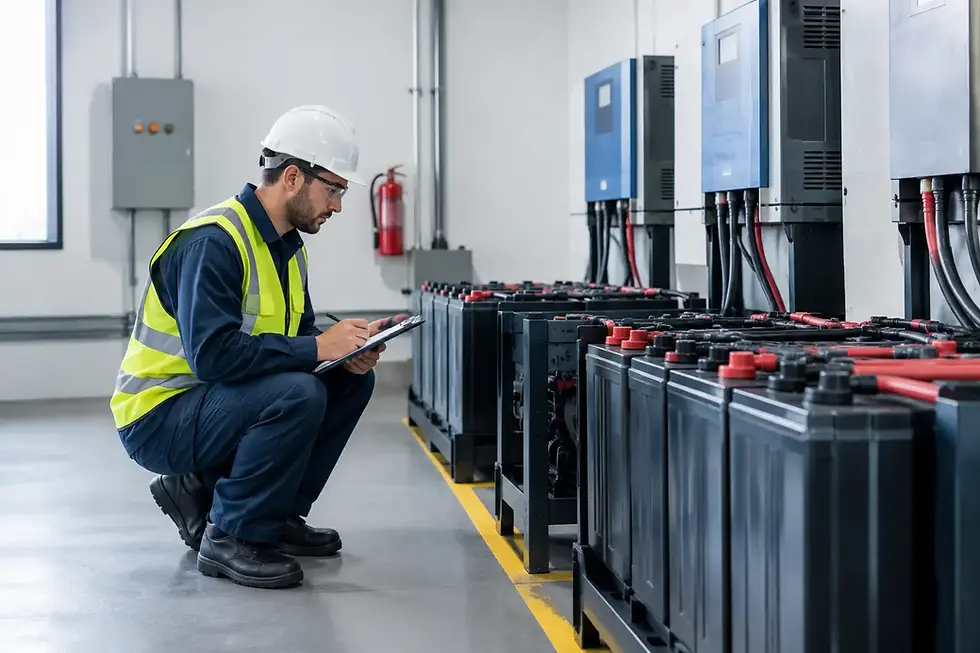
For electric forklifts and reach lorries, the battery is not an accessory. It is a high-value component that determines runtime, performance and replacement cost. Ask for the battery age, capacity, voltage, maintenance history and charging routine. A battery that has been regularly watered, equalised and charged correctly will usually provide more dependable service than one that has been neglected.
Inspect the battery case for cracks, swelling, acid residue, corrosion and damaged connectors. Examine cables and plugs for heat damage or temporary repairs. A battery should also be tested under load, not merely shown with a charger connected. Voltage readings, specific gravity checks for lead-acid batteries and a professional capacity test provide a more meaningful picture of remaining life.
Check the charger as well. Confirm that it is compatible with the battery voltage and amp-hour rating, and that it suits your site’s electrical supply. Replacing a weak battery or unsuitable charger after purchase can quickly remove the initial saving from a used electric forklift.
Lithium-ion batteries have different inspection priorities. Confirm the battery management system status, charging compatibility, warranty transfer terms and any manufacturer requirements for servicing. The higher upfront cost may be justified for multi-shift operations, but only if the battery specification matches your actual duty cycle.
Verify safety equipment and operator condition
A forklift must be safe before it can be productive. Test the horn, lights, reverse alarm, warning beacon, seat belt, seat switch, emergency stop, mirrors and display indicators. Check the overhead guard for damage and make sure the operator seat adjusts and locks correctly. Poor seating, worn pedals and stiff controls may seem minor during a short inspection but can affect operator comfort and control over a full shift.
Tyres should have adequate tread, no major chunking or sidewall damage, and even wear across the axle. Different tyre types or badly worn tyres can affect stability and ride quality. Inspect the wheels, nuts and axle areas for signs of impact or fluid leakage.
Do not accept a forklift without a clear demonstration of its safety functions. If a seller cannot explain faults, warning codes or previous repairs plainly, factor the uncertainty into the decision or walk away.
Ask for service records and parts support
Maintenance documentation often reveals more than the machine’s paintwork. Request service reports, repair invoices, inspection records and details of major replacement parts. Regular oil changes, filter replacements, chain inspections and brake servicing suggest a machine that has been managed properly. Repeated repairs to the same transmission, hydraulic or electrical component deserve investigation.
Before committing, confirm that replacement parts are available locally and that a qualified service provider can support the make and model. An uncommon imported unit can appear attractive until a failed controller, mast roller or seal kit causes weeks of waiting. In Johor Bahru, where warehouse schedules are often tight, access to responsive repairs, battery support and temporary rental cover can matter as much as the purchase price.
A pre-purchase inspection by an experienced forklift technician is a sensible safeguard, especially for higher-capacity machines, reach lorries and equipment with complex electronics. The cost is small compared with an unexpected transmission overhaul or battery replacement.
Compare the full cost, not just the asking price
Build your decision around the expected cost of ownership for the first 12 to 24 months. Include immediate repairs, tyres, battery replacement risk, planned servicing, inspection requirements, fuel or charging costs, parts availability and the likely cost of downtime. A cheaper forklift needing frequent attention can cost far more than a properly maintained unit with a higher initial price.
It also depends on how critical the machine is to your operation. For occasional use, a used forklift may be a practical purchase. For continuous production or intensive warehouse work, a maintenance arrangement and access to rental backup can protect uptime when an unexpected fault occurs.
Buy the machine that has been honestly assessed, properly matched to the work and backed by realistic service support. That is how a used forklift becomes a cost-effective asset rather than a disruption waiting to happen.


Comments