
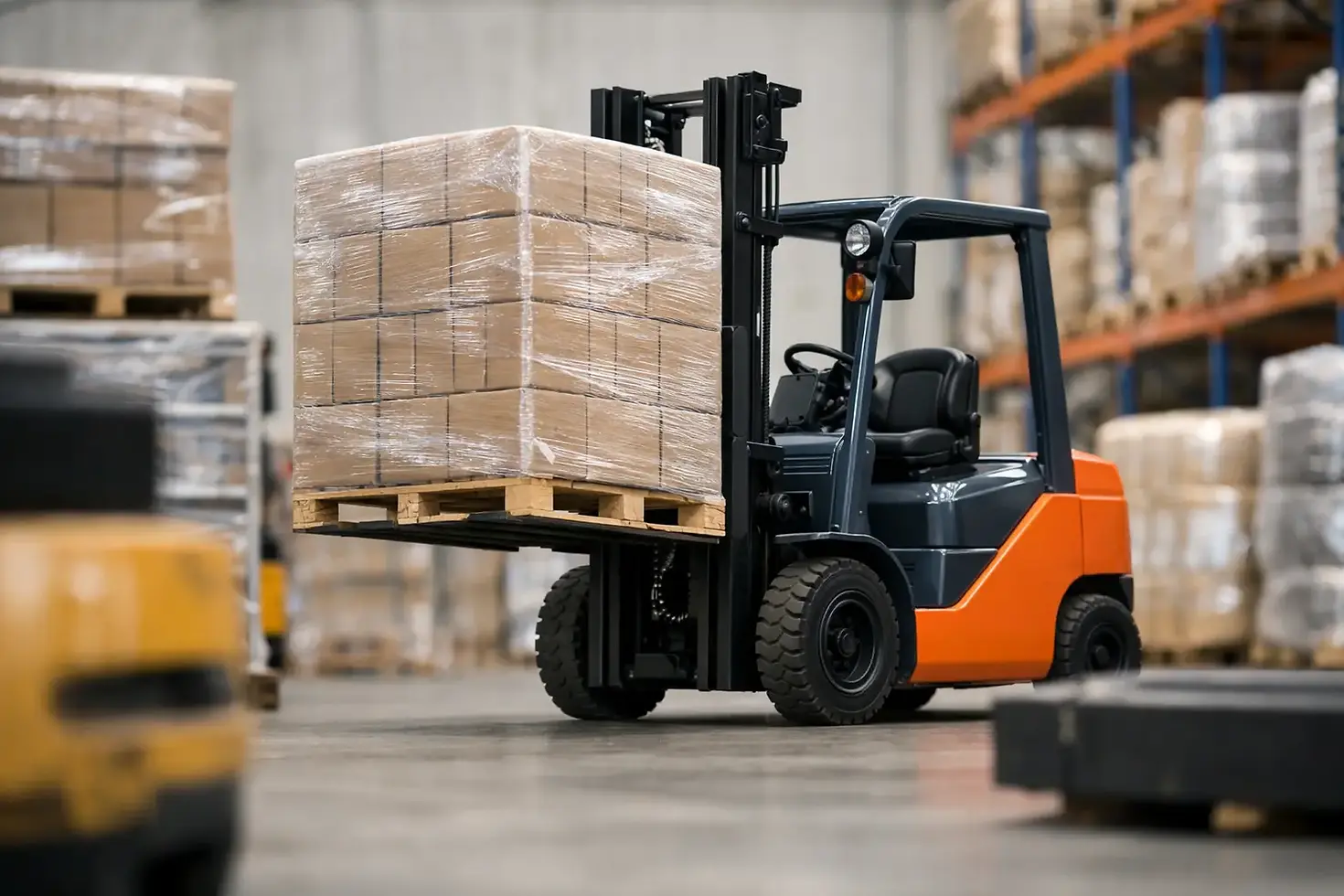
Forklift Capacity Requirements for Safe Operations

A forklift marked as a 2.5-tonne machine is not automatically safe for every 2.5-tonne load. Forklift capacity requirements depend on where the load’s weight sits, how high it must be lifted, the attachment fitted and the actual conditions on site. Getting this wrong can lead to unstable handling, damaged stock, tyre and mast wear, or a serious overturning incident.
For warehouse, factory and construction operations, capacity should be checked before equipment is purchased, hired or assigned to a new task. It is a practical uptime issue as well as a safety issue. A forklift that is too small creates delays and risk; one that is unnecessarily large can increase hire, fuel or battery, and operating costs.
What forklift capacity actually means
Rated capacity is the maximum load a forklift can lift under the conditions stated on its capacity plate. It is not simply the largest weight the machine may ever carry. The rating is based on a specified load centre, lift height, mast configuration, tyres and standard forks.
The load centre is particularly important. It is the horizontal distance from the fork face or load backrest to the load’s centre of gravity. Many counterbalance forklifts are rated at a 500 mm load centre. If a 2,500 kg forklift is rated at 500 mm, it can carry 2,500 kg only when the load’s centre of gravity remains at or within that distance.
Long pallets, bulky crates, paper rolls, machinery and loads that cannot sit close to the fork face move the centre of gravity forwards. That increases the overturning force on the forklift. The available lifting capacity reduces, even when the load’s stated weight stays the same.
Capacity is not a simple weight comparison
A quick comparison between the load weight and the number printed on the forklift body is not enough. A 2,000 kg load on a deep pallet may exceed the safe limit of a 2.5-tonne lorry if its load centre is significantly greater than the rating allows. The data plate, sometimes called the nameplate or capacity chart, is the deciding reference.
Operators should read the plate before lifting unfamiliar loads. Managers should also make sure the plate remains legible. If it is damaged, missing or no longer reflects the forklift’s current configuration, the equipment should not be treated as having its original rated capacity.
Forklift capacity requirements start with the real load
The first step is to define the heaviest load the operation needs to handle, including its pallet, stillage, wrapping and any lifting attachment. Estimate work from the actual load dimensions, not a standard pallet assumption.
Record the load weight, length, width, height and how it is picked up. A uniformly packed pallet behaves differently from a tall, uneven or partly loose load. If the load has an off-centre centre of gravity, as can happen with moulds, fabricated components and machine parts, that must be allowed for as well.
Lift height matters too. A forklift may have a reduced capacity at full mast extension compared with its capacity at ground level. This is common with high-lift warehouse applications, especially where racking heights are close to the machine’s limits. A reach lorry may be the better fit for narrow aisles and high storage, but it must still be selected against its rated capacity at the required height and reach.
Before choosing equipment, operations teams should confirm four practical points:
the maximum weight, dimensions and load centre of the goods being handled;
the highest lift point, including top beam clearance and racking position;
the travel route, floor condition, gradients and available aisle width; and
the attachment needed, if any, for clamps, rotators, extensions or specialised handling.
These details give a service provider or equipment supplier enough information to recommend a suitable capacity rather than making a rough estimate.
Attachments change the rated capacity
Attachments are useful, but they are not neutral additions. Fork extensions, side-shifters, fork positioners, bale clamps, carton clamps and rotators all add weight in front of the forklift and usually move the load further away from the mast. Both factors reduce residual capacity.
For example, a side-shifter improves positioning when loading lorries or placing pallets in racking. However, the attachment’s own weight and thickness alter the load centre. Longer forks can safely support longer loads only when they are correctly specified and the revised capacity has been calculated. Using extensions without checking this can create a false impression that the forklift is capable of lifting more.
Whenever an attachment is fitted, the forklift needs an updated capacity plate that identifies the attachment and the permitted load at the stated load centre and lift height. Do not rely on the original plate or a verbal assumption. A qualified technician should assess the configuration and provide the correct information before the forklift returns to service.
Site conditions affect the machine you need
Forklift capacity requirements are not determined inside the warehouse alone. The working surface, travel distance and environment influence the right lorry type and usable operating margin.
On smooth, level concrete, an electric forklift may handle palletised loads efficiently and cleanly indoors. On uneven yards, loading areas or construction sites, a diesel or LPG forklift with appropriate tyres, ground clearance and capacity may be more suitable. A load that is acceptable on level ground can become unsafe on a slope, across a pothole or while turning too quickly.
Aisle width also matters. Selecting a higher-capacity counterbalance forklift without checking turning space can restrict movement and slow loading. Conversely, choosing a narrow-aisle or reach lorry for storage density may require closer attention to floor flatness, racking condition, battery charging arrangements and lift-height capacity.
The best choice is often not the forklift with the highest headline rating. It is the machine with sufficient residual capacity, the correct mast and attachment, and the right dimensions for the work area.
Build in a sensible operating margin
Running permanently at the edge of a forklift’s rated capacity is rarely a good operational plan. Load weights vary, pallets are not always built consistently, and site conditions are not always ideal. A sensible margin allows for real-world variation without creating unnecessary overspend.
The size of that margin depends on the application. A controlled warehouse moving identical, verified pallets on level floors may need less allowance than a manufacturing site handling irregular components or a yard operation working over uneven surfaces. The key is to base the decision on the most demanding routine lift, not the average lift.
This also protects availability. Overloading and poor load handling place extra stress on tyres, forks, chains, hydraulics and mast components. Repeated strain can contribute to avoidable repairs and unexpected downtime. Planned servicing will identify wear, but selecting suitable equipment in the first place reduces the pressure on the machine.
Check the forklift before every shift
Capacity compliance is not only a procurement decision. It depends on daily checks and competent operation. Operators should confirm that the capacity plate is readable, forks are not cracked or excessively worn, tyres are in serviceable condition and hydraulic functions operate correctly.
Loads should be centred on both forks, carried low during travel and kept stable. Operators should avoid sudden turns, braking or acceleration with raised loads. They should also understand that a capacity plate is not permission to lift under every circumstance. Damaged pallets, loose goods, poor visibility, wind exposure outdoors and sloping ground may require a different handling method or a reduced load.
Where the load is unfamiliar, stop and verify its weight and dimensions. Guessing is not an efficient shortcut when a dropped load can stop a warehouse lane, damage racking or put people at risk.
When hire is the practical capacity solution
Capacity needs can change quickly. A business may need a larger forklift for a machinery delivery, seasonal stock build-up, container unloading or temporary production increase, without needing to buy and maintain that machine year-round.
Short-term or contract rental gives operations teams access to the required capacity when demand rises, while keeping owned equipment focused on daily work. It also provides a practical backup when an existing forklift is under repair or awaiting parts. The rental specification should still include the load weight, load centre, lift height, attachment, work surface and operating hours. A fast delivery is valuable only when the forklift arriving on site is suitable for the job.
For businesses in Johor Bahru managing mixed warehouse and industrial workloads, TTS Machinery can assess these details and arrange forklift or reach lorry support with the right service coverage. Clear information at the start helps avoid incorrect equipment selection, unnecessary delays and last-minute changes on site.
A forklift’s capacity plate is a working safety document, not a label to glance at once. Treat each new load, attachment and lift height as a reason to check the rating again. That small discipline keeps people safer, protects equipment and gives your operation a better chance of staying on schedule.



Comments