
Is an EP Lithium Battery Forklift Right?
- Kelvin Tan
- Aug 5
- 6 min read

A forklift that needs a battery change halfway through a busy shift can quickly become a bottleneck. An EP lithium battery forklift is designed to reduce that interruption by pairing electric material handling equipment with fast-charging lithium battery technology. For warehouses, factories and distribution operations where every hour of equipment availability matters, that can be a meaningful operational advantage.
The right choice still depends on the work. Load weights, shift patterns, available charging points, operator habits and service support all affect whether lithium is the best fit. The equipment should be assessed as part of the full operation, not simply compared by purchase price.
What an EP lithium battery forklift changes
A conventional lead-acid battery is a large consumable component that needs regular watering, controlled charging and, in many operations, a separate battery-changing routine. It may require spare batteries to cover multiple shifts, along with storage space and lifting equipment for safe exchanges.
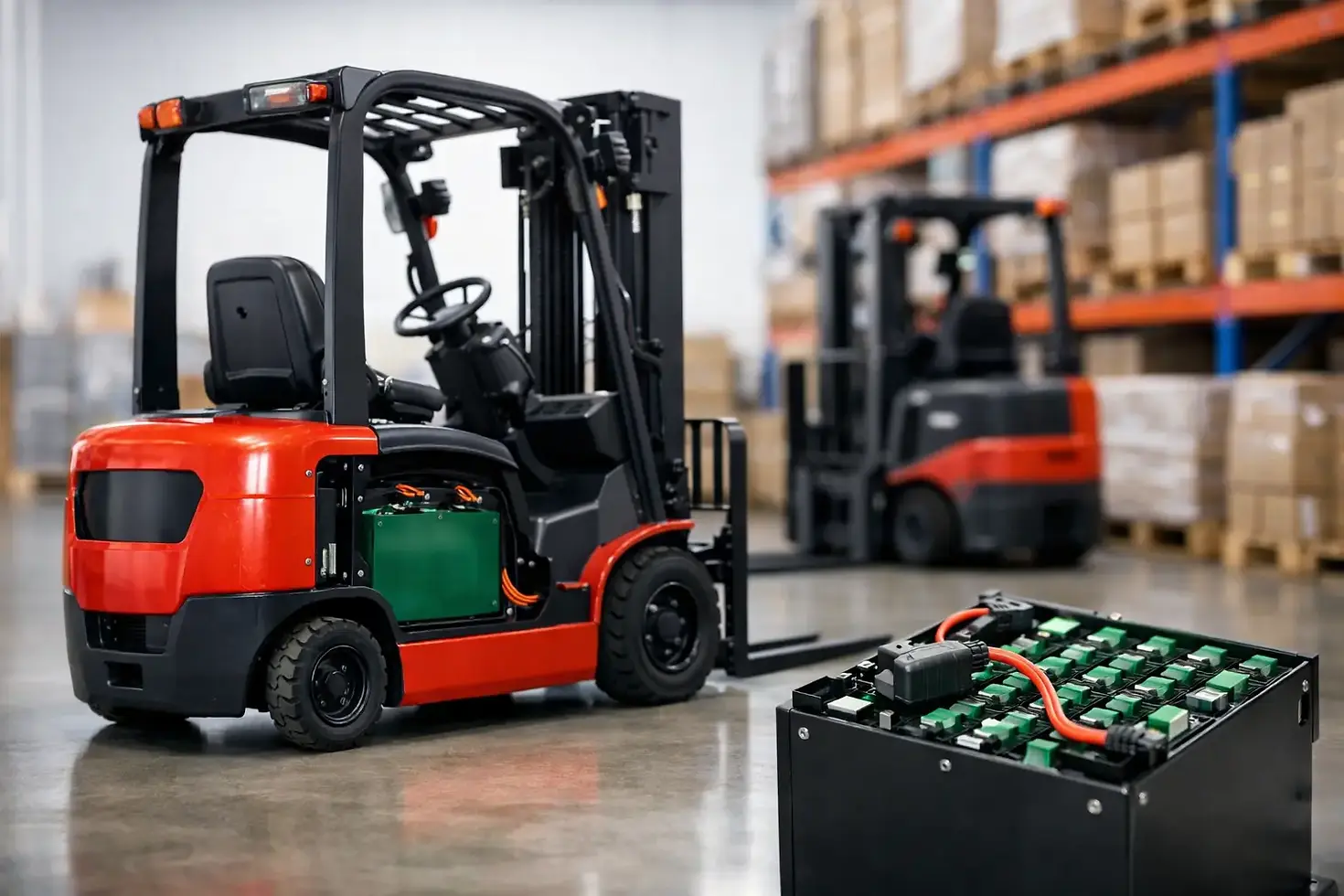
An EP lithium battery forklift uses a lithium-ion battery with an integrated battery management system. This system monitors charging, temperature and battery condition while helping protect the battery from unsuitable operation. The practical result is simpler daily battery handling. Operators can connect the charger during planned breaks or idle periods rather than wait for a full battery-change cycle.
This opportunity charging approach is particularly useful where a forklift works intermittently throughout the day. A machine loading a lorry in the morning, moving stock at midday and supporting despatch in the afternoon can recover useful charge between tasks. Instead of treating charging as a separate activity at the end of a shift, it becomes part of normal operating discipline.
Lithium technology also maintains more consistent power as the charge level reduces. This can support predictable travel and lifting performance during a working shift. However, actual runtime will always vary according to the forklift model, load, travel distance, gradients, attachments, ambient conditions and driving style.
Where lithium forklifts make commercial sense
The strongest case for lithium is usually not just lower battery maintenance. It is the ability to keep a productive machine available with less disruption.
For multi-shift warehouses, the removal of battery swapping can save time and floor space. For food, pharmaceutical and clean production environments, a sealed battery system can reduce concerns associated with battery acid, fumes and watering. For operations with a limited forklift fleet, rapid charging can provide greater flexibility when one machine must cover several tasks.
A lithium forklift can also be a practical fit for businesses replacing ageing electric equipment. If the existing battery room is difficult to manage, batteries are nearing the end of their useful life or staff regularly lose time changing batteries, the switch can simplify the operation.
That said, lithium is not automatically the lowest-cost option for every site. A single-shift operation with light usage and a well-maintained lead-acid battery may not see the same immediate return. Likewise, a site with unreliable electrical supply or no suitable place for charging must resolve those issues before investing in a lithium fleet.
Charging planning is more important than many buyers expect
Fast charging is valuable only when it is planned properly. The charger, electrical capacity and charging location need to match the equipment and the way it will be used. Installing a charger wherever space happens to be available can create avoidable delays, cable hazards or congestion around busy aisles.
Start with the daily working pattern. Identify when each forklift is active, how far it travels, when operators take breaks and whether it is used continuously for intensive loading. This information helps determine whether one charging point is enough or whether multiple units will require scheduled access.
The charging area should be accessible without forcing the forklift to make unnecessary journeys. It must also be kept clear, protected from impact and managed according to site safety procedures. Chargers and connectors should be inspected regularly, even though lithium systems generally require less day-to-day attention than lead-acid batteries.
For a fleet operating across long shifts, it is sensible to agree simple rules with operators. Charge during authorised breaks where appropriate, report warning messages promptly and avoid leaving equipment at an unsuitable low state of charge. Good habits protect availability better than relying on technology alone.
Runtime should be assessed against the actual duty cycle
Manufacturers may quote runtime figures, but these should be treated as a guide rather than a guarantee. A forklift that carries light pallet loads over smooth warehouse floors will consume energy differently from one that travels outdoors, handles heavier materials or repeatedly climbs ramps.
Before selecting an EP lithium battery forklift, record a typical week of use. Include average load weight, lifting height, travel routes, hours of operation and any peak periods. This gives a service provider or equipment specialist the information needed to recommend a suitable battery capacity and charger arrangement.
It is also worth considering seasonal peaks. A forklift that is adequate for ordinary volume may struggle during a year-end rush, a major project or a temporary increase in production. Rental support can be useful in these periods, allowing the business to add capacity without making a rushed equipment purchase.
Maintenance needs are lower, not zero
Lithium batteries do not need watering and do not follow the same equalisation charging routines as traditional lead-acid batteries. This reduces routine labour and removes several common causes of battery damage. There is no acid top-up schedule to miss, and no need to change batteries between shifts in many applications.
But the forklift itself still requires planned servicing. Tyres, brakes, steering, hydraulics, mast rollers, forks, electrical connections and safety devices remain essential to safe operation. A clean battery system does not prevent a machine from stopping due to a worn contactor, damaged cable, hydraulic leak or neglected drive component.
The best approach is to combine battery monitoring with scheduled forklift maintenance. Technicians should check charging connectors, inspect cables for wear, review fault codes where applicable and confirm that the battery and charger are operating correctly. These checks are especially important for forklifts working in dusty, humid or demanding industrial environments.
When a fault occurs, fast diagnosis matters. A battery warning does not always mean the battery is the problem. It can be related to the charger, vehicle wiring, connectors or another electrical component. Replacing parts without proper checks can increase cost and extend downtime.
Comparing lithium with lead-acid batteries
The decision should be based on total operating cost and availability, not a single headline figure. Lithium batteries typically have a higher initial cost, while lead-acid systems can appear less expensive at the point of purchase. Over time, however, lithium may reduce labour, charging downtime, maintenance requirements and the need for spare battery sets.
Lead-acid remains suitable for some operations, particularly where work is predictable, shifts are limited and charging can take place overnight. It is a familiar technology, and many sites already have the charging infrastructure and procedures in place.
Lithium tends to be more attractive where utilisation is high, space is constrained or forklifts need to return to work quickly. The higher initial investment may be justified when it prevents lost loading time, reduces dependence on spare batteries and makes better use of a smaller fleet.
A fair assessment should include the cost of chargers, installation, electrical upgrades, maintenance, operator training and likely equipment use over several years. It should also account for the cost of downtime. A forklift that is unavailable during a critical despatch window can cost far more than the hourly rental or repair charge needed to keep the operation moving.
Questions to ask before committing
Before purchasing or renting, confirm the required lift capacity, lift height, aisle width, tyre type and operating environment. Then ask how the battery capacity matches your duty cycle, what charging equipment is included, how long charging takes under normal conditions and what support is available if the equipment develops a fault.
It is equally useful to ask about parts availability and planned maintenance. A forklift is only as dependable as the support behind it. Local technical coverage, responsive breakdown assistance and access to replacement parts can make the difference between a short interruption and a lost day of productivity.
For businesses in Johor Bahru managing demanding material handling schedules, TTS Machinery can help assess whether an EP lithium battery forklift matches the site, workload and budget. The most useful equipment decision is the one that gives your operators a reliable machine, your managers predictable costs and your operation fewer reasons to stop.


Comments