

Repair or Replace a Forklift? Know When to Act

A forklift that stops halfway through a loading schedule creates a decision that cannot wait for the next budget meeting. The question is whether to repair or replace forklift equipment without spending unnecessarily or exposing operators to further breakdowns. The right answer depends on more than the latest repair quote. It depends on safety, recurring downtime, parts availability, workload and the true cost of keeping the machine in service.
For warehouse, factory and construction operations, a repair can be the most cost-effective solution. In other cases, continuing to repair an ageing unit only shifts a larger cost into the next month. A practical assessment helps management make the call with confidence.
Repair or Replace a Forklift: Start With Safety
Safety is the first decision point, not the last. A forklift with damaged forks, poor braking performance, steering faults, mast issues, hydraulic leaks or unreliable warning systems should be removed from use until it has been inspected and repaired. These are not faults to work around during a busy shift.
A repair is usually sensible when the fault is isolated, the machine has been properly maintained and the required parts are available. Replacing a worn hose, repairing a hydraulic cylinder, servicing brakes or fitting a new battery may restore dependable operation at a reasonable cost. The key is that the repair addresses the root cause rather than only the visible symptom.
Replacement deserves stronger consideration when structural damage is involved, safety-critical components cannot be restored to specification, or the forklift has become unreliable despite repeated repairs. A lower purchase price never justifies placing operators, stock or nearby personnel at risk.
Look Beyond the Latest Repair Bill
One expensive invoice does not automatically mean a forklift should be replaced. Major repairs can be worthwhile on a well-maintained machine with suitable capacity and many productive years remaining. Equally, a series of modest invoices can become more damaging than one large repair because of the disruption each failure causes.
Review the previous 12 to 24 months of repair records. Include call-out charges, parts, labour, transport, temporary rental and lost working time. If repair costs are increasing steadily, or the same systems keep failing, the unit may be approaching the point where replacement is financially sound.
Downtime should be given a value, even if it does not appear directly on a supplier invoice. Consider delayed despatches, production stoppages, overtime, missed delivery slots and staff waiting for equipment. A forklift that is technically repairable but regularly unavailable can cost more than a replacement or rental arrangement.
A useful cost comparison
Compare the expected cost of keeping the current forklift for the next year against the cost of acquiring or renting a more reliable unit. The calculation should include planned servicing, likely repairs, battery condition, tyre wear and the operational cost of breakdowns.
There is no fixed percentage that applies to every business. However, when a repair is substantial and the forklift has a pattern of costly faults, it is sensible to price a replacement option at the same time. This gives procurement and operations a real comparison instead of a decision based on urgency alone.
Consider Age, Hours and Working Conditions
Forklift age matters, but operating hours and application matter more. A ten-year-old forklift used lightly in a clean warehouse may remain a good repair candidate. A younger unit working long shifts on uneven ground, in heat, dust, cold storage or corrosive conditions may wear faster and require more intensive support.
High-hour equipment is not automatically unsuitable. What matters is its service history and present condition. Regular servicing, correct lubrication, timely filter changes and trained operation can significantly extend a forklift's working life. Poor maintenance, overloading and unsuitable attachments shorten it quickly.
Ask whether the machine still matches the job. A growing warehouse may now need greater lift height, narrow-aisle manoeuvrability, a different attachment or longer battery runtime. Repairing an existing forklift makes little sense if it no longer supports the way the operation works.
Battery Problems Do Not Always Mean Replacement
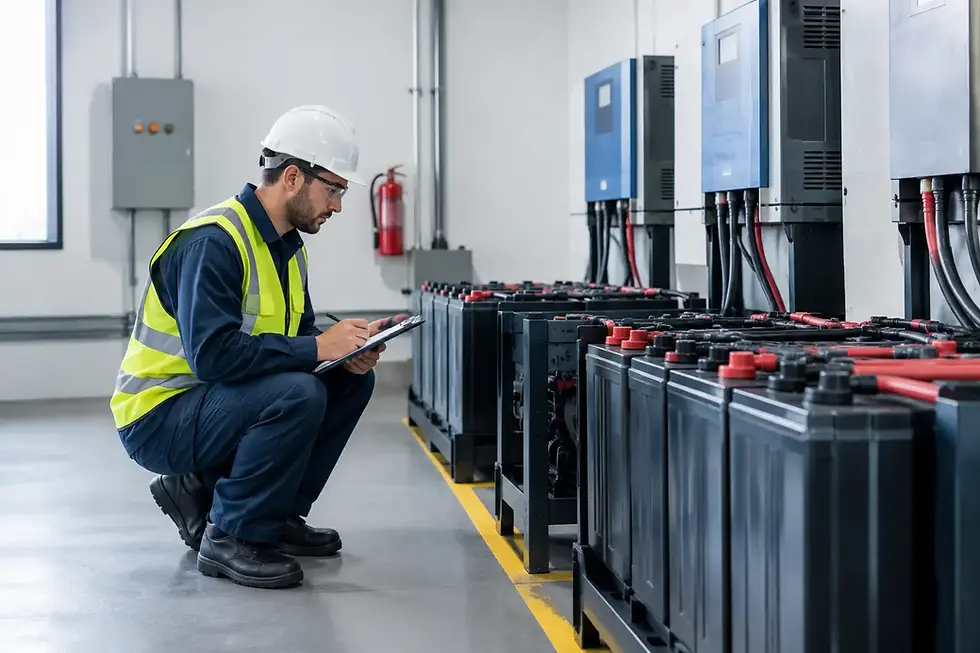
Electric forklift performance is often judged by its battery. Slow lifting, reduced running time and charging difficulties can look like a failing forklift when the underlying issue is the battery, charger, cable connection or maintenance routine.
Before replacing the whole machine, arrange a battery and charging-system assessment. Individual battery faults, damaged connectors, low electrolyte levels in suitable battery types, poor charging practices or an unsuitable charger may be repairable. Reconditioning or replacing the battery can return an otherwise sound electric forklift to useful service.
That said, battery investment should be assessed alongside the condition of the forklift itself. Fitting a costly new battery to a machine with recurring hydraulic, mast and drive issues may not be the best use of capital. The battery decision and the equipment decision should be made together.
Parts Availability Changes the Equation
A forklift can only be repaired quickly if the right parts can be sourced. Older, uncommon or discontinued models may remain serviceable, but lead times for critical parts can turn a manageable fault into prolonged downtime. This is especially important for businesses that rely on one or two units rather than a larger fleet.
If key components are becoming difficult to obtain, replacement may offer better protection against future disruption. A newer or more commonly supported model can simplify servicing, reduce waiting time for parts and make maintenance costs easier to predict.
When a repair is still the preferred route, ask for a clear quotation that identifies the fault, parts required, expected turnaround and whether related wear items should be addressed at the same visit. An honest and fair quote helps avoid repeated call-outs for issues that could have been resolved together.
Use Rental to Protect Uptime While You Decide
The repair-or-replace decision does not have to force an immediate purchase. Short-term or contract forklift rental can keep loading, production and despatch moving while a damaged unit is repaired, assessed or replaced. It is also useful during seasonal peaks, warehouse expansion or periods when one fleet unit is unavailable.
Rental gives operations teams time to choose the correct capacity and configuration instead of accepting the first available replacement. It can also show whether a different type of forklift or reach truck would improve productivity in the actual working environment.
For Johor Bahru operations, fast onsite support and access to replacement equipment can be the difference between a contained equipment issue and a missed customer commitment. The priority is not simply getting a forklift back on site. It is restoring safe, dependable material flow.
Prevent the Next Forced Decision
Many replacement decisions become urgent because faults were allowed to develop unnoticed. Quarterly or annual servicing plans make it easier to spot tyre wear, hydraulic seepage, worn lift chains, brake deterioration, battery weakness and charging problems before they become a breakdown.
Operators also play a valuable role. A clear daily pre-use check and prompt reporting of unusual noise, reduced lifting performance, steering changes or fluid leaks allow repairs to be planned before the forklift fails during a critical shift. Small faults are generally quicker and less costly to correct.
TTS Machinery supports businesses with onsite repairs, scheduled maintenance, parts and battery solutions, as well as rental options when equipment availability is under pressure. The practical goal is to help each customer spend money where it protects uptime rather than repeatedly reacting to avoidable faults.
A forklift should be repaired when the work is safe, targeted and likely to restore reliable service at a sensible cost. It should be replaced when repeated downtime, safety concerns, poor parts availability or changing operational needs make continued repairs a false economy. Make the decision early, with repair history and operating requirements in hand, so your next breakdown does not make it for you.


Comments